Can packaging sustainability and food protection go hand in hand? Absolutely.
SCROLL

The Advanced Packaging Association (APA) is pleased to present this exclusive interview with Dr. Gary Ward, Chief Technology Officer of StePacPPC, a global leader in precision-engineered modified atmosphere packaging (MAP) solutions for fresh produce and a proud member of APA. With more than 20 years of combined experience in academia and the fresh produce industry, Dr. Ward has dedicated his career to developing science-based packaging solutions that extend shelf life, reduce food waste, and support more sustainable supply chains. In this exchange, he shares StePacPPC’s perspective on the critical role of MAP technology, and polyamide-based films in particular, in tackling food waste, enabling season extension and long-distance shipments of fresh produce, contributing to a balanced approach to packaging sustainability. This conversation reflects APA’s commitment to evidence-based dialogue and its recognition that protecting food and advancing recyclability goals are not competing objectives — both are essential, and both are achievable together.
- What role does Modified Atmosphere Packaging (MAP) play in reducing food waste in fresh produce supply chains?
Fresh fruits and vegetables continue to respire after harvest and shelf life is typically indirectly correlated with respiration rate, i.e. the higher the respiration rate the shorter the shelf life and vice versa. Hence reducing respiration rate helps preserve quality. Since respiration rate is correlated with temperature, the best way to slow spoilage is to cool the produce immediately after harvest and maintain the cold chain thereafter.
It is well known that a combination of low oxygen and elevated carbon dioxide also slows respiration of many types of fresh produce in addition to inhibiting ethylene activity and suppressing microbial decay. This three-pronged effect can be exploited by taking a semi-permeable membrane, in our case flexible plastic packaging, and tailoring the permeability in accordance with the respiration rate of the produce to achieve a produce specific “modified atmosphere” of low oxygen and elevated carbon dioxide that significantly extends shelf life.
MAP is widely used in the fresh produce industry for season extension, long-distance shipments and for preserving quality at retail. Extending shelf life through MAP substantially reduces food losses along the supply chain and enables sea freight as a viable alternative to air freight, both of which contribute to measurable reductions in the overall carbon footprint associated with fresh produce distribution.
- How does MAP, and polyamide-based films specifically, enable longer transportation distances while reducing food waste?
One of the biggest challenges in MAP is moisture management. During respiration, fresh produce generates water vapor. As relative humidity inside the package increases, dehydration and weight loss are reduced, which is beneficial. However, in conventional polyolefin packaging, characterized by relatively low water vapor transmission rates (WVTR), the water vapor has nowhere to escape to and when it condenses, the resulting free moisture promotes microbial decay.
This is where polyamide films, with high WVTR, play a key role. Their ability to release excess moisture generated during the respiration process helps mitigate the risk of microbial decay. However, there is always a trade-off: the more moisture that is released, the greater the potential for dehydration.
For this reason, StePacPPC deploys polyamide-based films with a range of WVTR so that the optimal balance can be achieved for each produce type, product geometry, and supply chain, the “sweet spot” between minimizing microbial decay and avoiding excessive dehydration.
MAP solutions manufactured using polyamide films provide a level of combined gas and moisture control that cannot be achieved with polyethylene-based films. This allows the freshness of high-respiration moisture-sensitive produce, such as green beans, cucumbers and melons, to be maintained during lengthy shipments, minimizing spoilage, enabling access to distant markets and allowing sea freight as opposed to air freight.
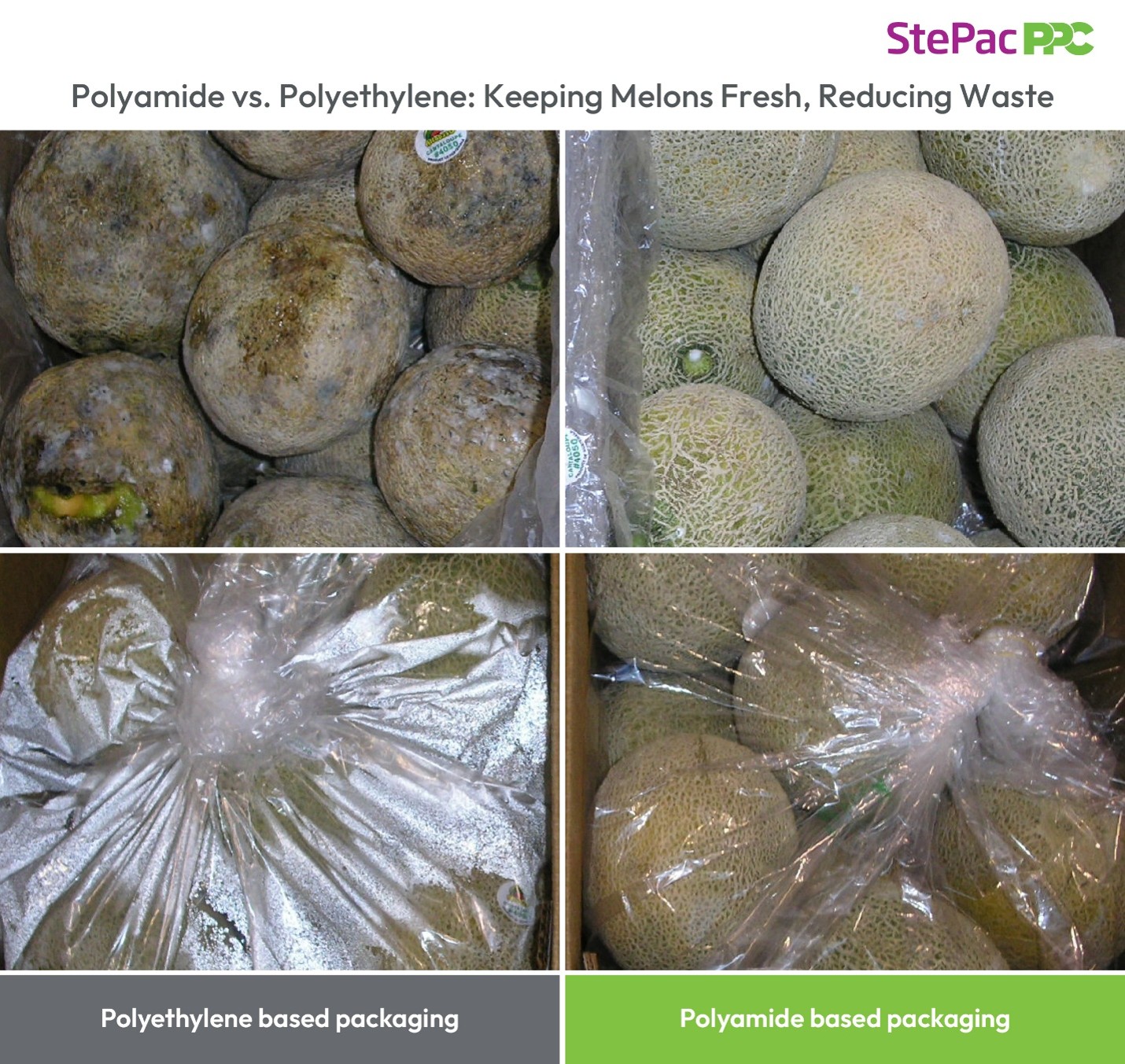
For example, polyamide-based MAP solutions are used for sea freight of Cantaloupe and Galia melons from Latin America to Europe, helping preserve the quality during transit. Replacing polyamide with polyethylene-based films increases losses associated with microbial decay (Figure 1) and creates additional costs due to the need to repack wet fruit. These resulting food waste and logistical burdens far exceed the perceived environmental benefits of using what is considered by many as a more sustainable film.
- How does reducing food waste with MAP contribute to sustainability, and why are polyamide films essential in this?
Reducing food waste conserves, the vast resources required to grow, harvest and distribute fresh produce. Food waste accounts for approximately 8% of global greenhouse gas emissions, making it a major contributor to global warming, one of the greatest threats facing our planet.
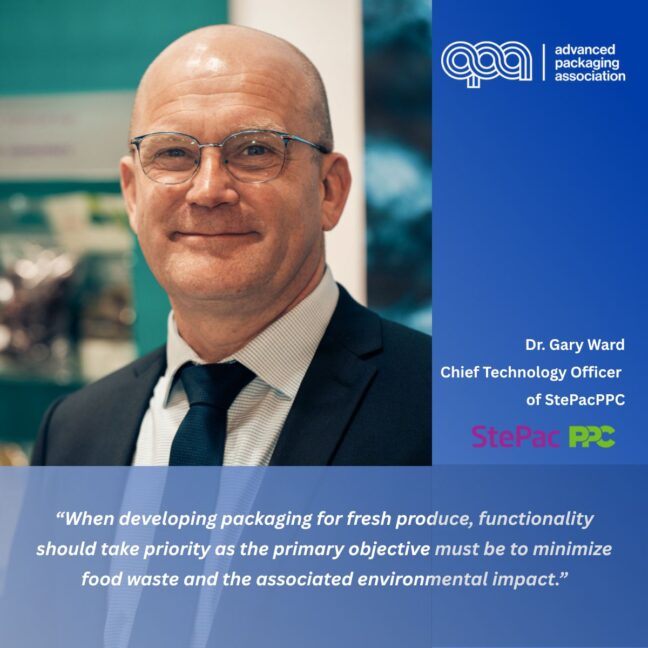
For this reason, when developing packaging for fresh produce, functionality should take priority as the primary objective must be to minimize food waste and the associated environmental impact.
Polyamide-based films, play a unique role in moisture management within MAP and in many applications cannot be easily replaced by alternative materials. Their ability to balance gas permeability and water vapor transmission is critical for maintaining quality and minimizing spoilage of many fresh produce items.
As a result, the environmental benefits gained from reducing food waste and enabling more efficient transport often far outweigh the environmental impact associated with the packaging material itself.
Research conducted by StePacPPC in collaboration with Wageningen calculated the savings in CO₂ emissions associated with using MAP across different produce items and supply chains. Based on this research StePacPPC estimates that its packaging contributes to annual savings of more than 100,000 tons CO2 emissions, equivalent to the annual amount produced by 31,000 passenger vehicles.
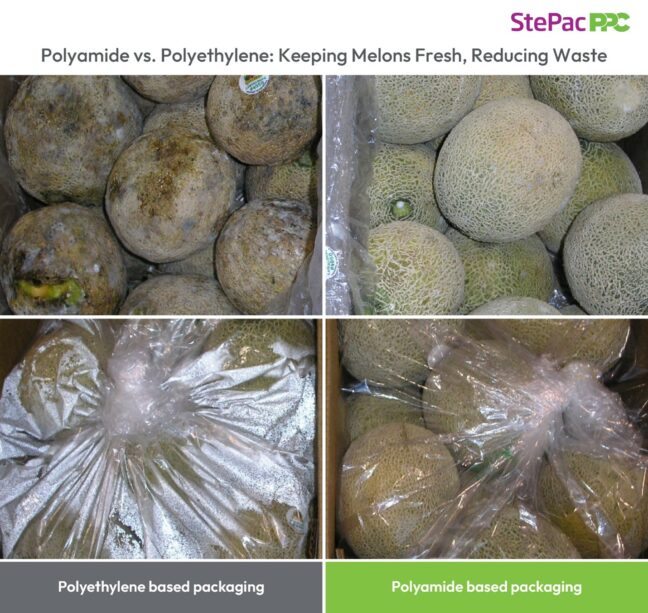
Figure 1: Melons Packaged in Polyethylene Packaging (left) vs. StePacPPC’s Polyamide-based packaging (right). For sea shipments of melons, polyethylene-based packaging significantly increases the risk of microbial decay and the resulting food waste. Although polyethylene is often perceived as the more sustainable packaging material, the ability of polyamide-based films to substantially reduce spoilage and food waste can deliver a lower overall environmental impact across the product life cycle.